A self-test isn't an exam. Even so, there are a few things that regularly go wrong, and almost all of them have the same consequence: the sample can't be analysed, or the result says less than you think.
The good news is that none of these mistakes is complicated to avoid. You just have to know they exist.
Mistake 1: Testing too early
The most common one and the most annoying, because it can render a perfectly executed test kit worthless.
Every pathogen needs a certain amount of time before it's detectable. With chlamydia and gonorrhoea that happens relatively quickly, because the test looks directly for the genetic material. With HIV, syphilis and hepatitis C it takes longer, because your body has to form antibodies first.
If you test two days after a risk contact, chances are you're measuring the period before it. The result isn't wrong in that case, it just answers a different question than the one you asked.
What helps: count from your last risk contact, not from the order date. If you're not sure whether enough time has passed, it's better to wait the extra week. And if you already have symptoms, test right away rather than waiting for some deadline to pass.
Mistake 2: Only testing one site
The mistake that happens in standard care at least as often as at home.
Chlamydia and gonococci often sit where the contact took place. If you had oral sex, you can have an infection in your throat. If you had anal sex, you can have a rectal infection. And a urine sample simply doesn't pick up either of them. And unfortunately, pathogens can migrate, so they suddenly settle in the rectum even though you didn't have anal sex at all.
This isn't a fringe issue. A considerable share of rectal and pharyngeal infections run completely without symptoms and would slip through a urine-only test.
What helps: the simple rule is to test where pathogens can settle. All the sites, not just the most convenient one.
Mistake 3: Swabbing too gently
This is the real classic when it comes to swabbing. People are understandably cautious with their own bodies and then just dab briefly at the surface.
The problem: a swab collects cells, not fluid. Without contact with the mucous membrane and without a rotating movement, too little material stays on the swab, and the lab can't analyse it.
Throat: The swab has to be guided over the tonsils and the back wall of the throat, with pressure and with rotation. A slight gag reflex is normal and a good sign that you were in the right place. A swab that only brushes over the tongue does nothing.
Anal: The swab is inserted a few centimetres and rotated there for several seconds. Not just along the outside.
For the blood drop, the same principle applies in a different form: too little blood means no analysis. Warm your hands up first (for example with warm water), let your arm hang down and let the drops fall freely rather than squeezing your finger hard. Vigorous milking destroys the blood cells and makes the sample unusable.
Mistake 4: Contaminating the sample
A cleanly taken swab can still become unusable if something interferes along the way.
The swab touches something else. The sink, a towel, clothing, your fingers on the front end. From that moment it's contaminated and you need a new one.
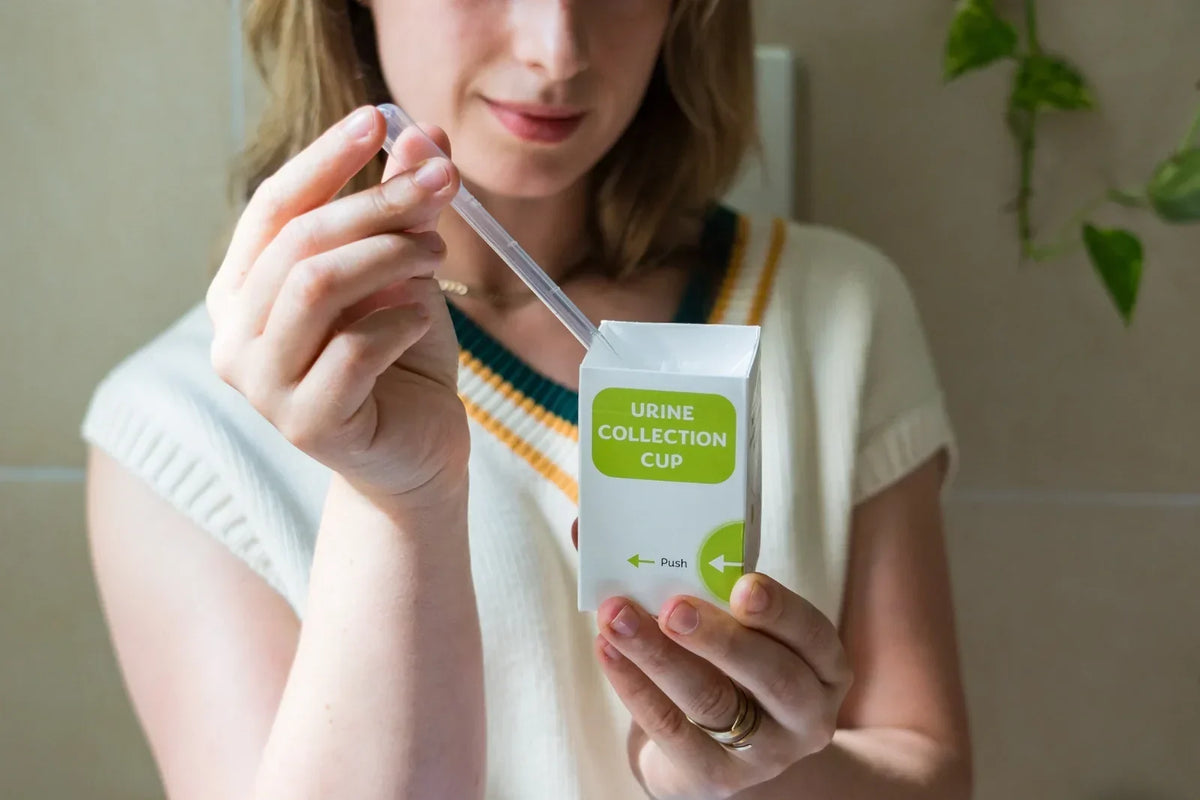
Urine at the wrong time. For the urine sample you need the first-catch stream, meaning the first few millilitres, and not the midstream that you'd give for a normal urine test. On top of that, you shouldn't have urinated for at least an hour beforehand. If you went to the toilet shortly before, you flush the pathogens away.
Brushed your teeth or used mouthwash before the throat swab. Antiseptic products can affect the result. Don't eat or drink beforehand, which applies above all to the minutes immediately before.
Antibiotics in play. If you've taken antibiotics in the past few weeks for other reasons, the result can be distorted. That's not a reason not to test, but a reason to mention it with your result.
Mistake 5: The journey to the lab
The part nobody thinks about, and that regularly tips the whole thing over anyway.
Not activating your test. Without activation via the QR code (or a manual activation), your sample can't be matched to you at the lab. This is the step that gets forgotten most often.
Tubes unlabelled or mislabelled. Two unlabelled samples look the same to the lab and can't be matched either.
Posted on a Friday afternoon. Then the sample sits in a postbox over the weekend. In hot weather that's not a good idea. Monday to Wednesday is the best time.
Left lying in the bathroom for days. Samples belong in the return envelope and the postbox promptly. Not left until the following weekend.
And the mistake that isn't one of these five
Your test kit sits in the drawer and doesn't get used.
That's not a usage error, it's a very human response. As long as you don't test, you don't have to deal with any result. Only that doesn't change reality, it just pushes it back. And everything this is about is easily treatable once you know.
The 30-second check
Before you get started:
- Is your last risk contact far enough in the past?
- Do you have all the relevant sites covered?
- Is the test activated?
- Have you urinated in the last hour?
- Is the return envelope within reach?
Reality Check comes with instructions that walk you through it step by step. When in doubt, they're always what counts, not what you've pieced together from the internet. Once your sample arrives at the partner lab, you get your result within 24 hours, digitally and confidentially. And if you have questions, we're always here for you.