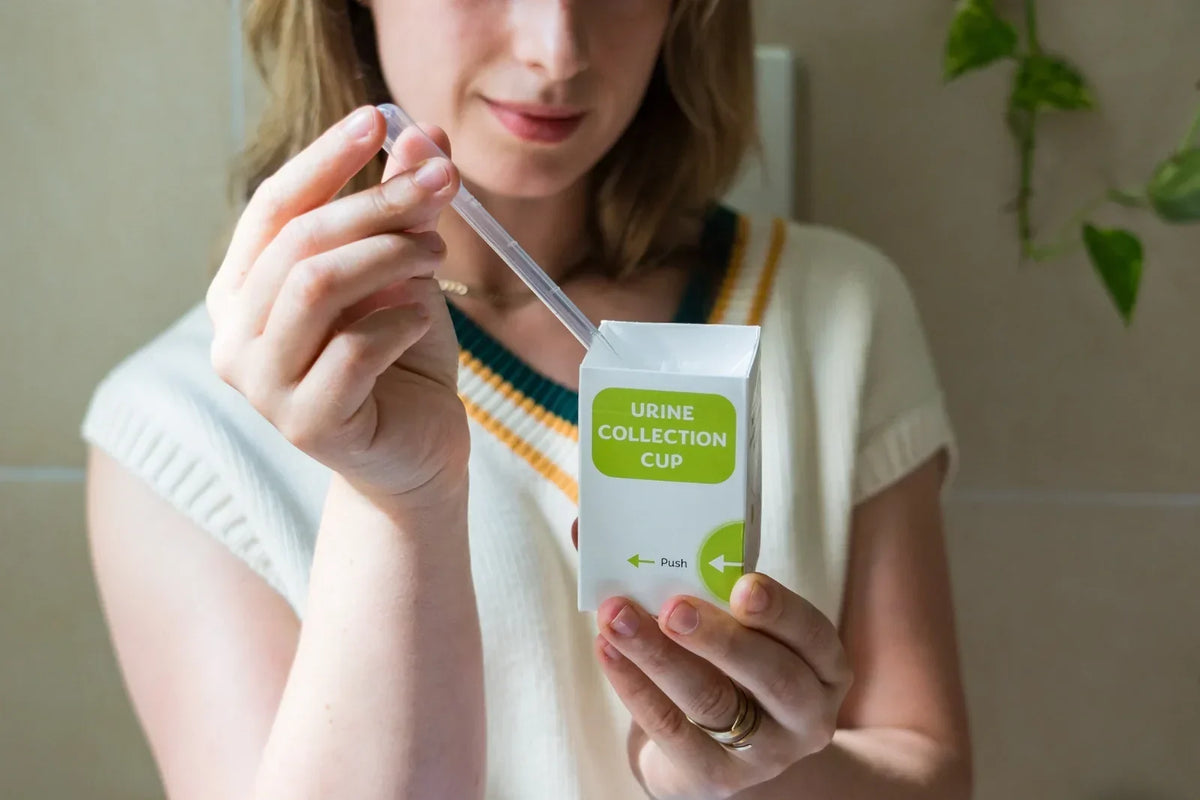


You're on the sofa in the evening, answering a handful of questions about your body, and then you hit send. No waiting room, no old magazines, nobody calling your name down a corridor. And right about then the thought turns up: was that medicine, or just a form?
Fair question. So here's the answer, step by step.
The questionnaire is the consultation
In a clinic, the part where someone asks you about previous conditions, medication and symptoms is called taking a history. It isn't a warm-up before the real examination. In a lot of cases it is the examination itself. A large share of all diagnoses comes from nothing more than what people say about themselves.
That's exactly the part that happens in writing with us. What changes is the setting, not the substance.
And the written version has a few things going for it. It never forgets a question, including the awkward one at number 14. It isn't under time pressure, because there's nobody waiting outside for their slot. It doesn't look at you while you answer. Anyone who has had to explain in a brightly lit consulting room how many sexual partners they've had in the past six months knows that isn't a small thing. On your own sofa, the honest answer comes a lot more easily to most people.
What clinicians are actually looking for in your answers
From the outside, some of the questions look arbitrary. From a medical point of view, nearly every one of them has a job to do. Broadly, four of them.
Does this treatment fit what you came for? Sounds obvious, isn't. People sometimes order the thing they've heard of rather than the thing that suits their situation. Part of the questionnaire is simply there to tell those two apart.
Is there anything against it? These are the contraindications. Certain cardiovascular conditions, certain medicines, allergies, kidney or liver function. With treatments for erection problems, for instance, there are combinations that can drop your blood pressure dangerously low. That's why we ask, not because we enjoy building forms.
Does it get along with everything else you take? Interactions aren't limited to prescription medicines. Supplements count, herbal products count and recreational drugs count most of all. Those last ones aren't a moral category for us, they're a pharmacological one. Telling us about them makes your treatment safer.
Could something else be going on? Some complaints are a symptom rather than a diagnosis. Erection problems can be an early sign of changes in the blood vessels, years before the heart says anything. Ongoing gut trouble can be harmless, or it can be the opposite. Part of the questionnaire exists precisely to catch those cases and pass them on instead of covering them with a prescription.
Who's actually reading it
Short answer: licensed doctors. Not an algorithm counting tick boxes and firing out a prescription.
Software does the groundwork. It sorts, checks for completeness and flags anything unusual. The medical decision afterwards is made by a qualified person who carries the responsibility for it, exactly as they would in a clinic.
This isn't a grey area, by the way. Until 2018, German medical law largely prohibited treating someone without ever seeing them in person. The German Medical Assembly changed that. Since then, remote treatment is permitted in individual cases where it is medically justifiable, where the required standard of care is maintained and where you've been told how this form of treatment works. It gets documented the same way any in person consultation would.
The standard, in other words, is the same. Only the route there is different.
Three possible outcomes
Once it's been reviewed, there are exactly three ways this goes.
Approved. Everything fits, you get a treatment recommendation and, where there's a clear indication, a prescription. The partner pharmacy sends it out, or you collect it from a pharmacy of your choice.
A question back. Something is unclear or doesn't add up. Then someone gets in touch rather than guessing. That's not a bad sign. It's the moment the whole process was built for.
A no. Sometimes the answer is no. Because there's a contraindication, because your symptoms belong in a room with someone who can examine you, or because what you ordered isn't the right thing in your case.
That third one rarely gets talked about, and it's the most telling of the three. A platform that waves every request through doesn't have a medical review. It has a checkout with a stethoscope painted on it.
Answering honestly is in your own interest
The questionnaire is only as good as what you put into it. Nobody at this end knows you, your neighbourhood, your family or your ex. There's no eyebrow going up in surprise.
More to the point, there's no answer that makes you look worse. Lots of partners, sex while using substances, a test you've been putting off for two years: all of that is medical information, not a question of character. It changes the recommendation, never the way you're treated.
Fudge the answers and you end up with a treatment that suits somebody else.
Where online stops
Telemedicine can do a lot. It can't do everything, and providers who suggest otherwise should give you pause.
Anything that needs someone to touch, listen to or look at you directly isn't going to work digitally. Severe or sudden pain belongs in a clinic or an emergency department, as does a fever that leaves you genuinely unwell, a painful swelling in a testicle or an erection that won't go away on its own. An unclear result that needs following up also needs an appointment in person.
What the digital route handles well is everything that can be planned. Prevention, testing, recurring issues, treatments with clearly defined conditions. Which happens to cover a fairly large slice of what people otherwise book an appointment for and then wait three weeks to get.
With sexual health there's something else on top. Plenty of people never walk into a clinic with these topics at all, because getting through the door feels too uncomfortable. A test you do at home and post back isn't the lesser version of an appointment in that equation. It's the version that actually happens. That's what Reality Check is for.
What happens to your answers
What you tell us is health data, which makes it the most strictly protected category of personal information there is. It's stored encrypted, processed within the EU and only the people involved in your treatment can see it.
Delivery is neutral, with nothing on the outside that gives away what's inside.
The waiting room was never the proof
The thing standing between you and good care was never the time spent in a waiting room. What counts is the right questions, a qualified person reading the answers and a clear no when no is the right answer.
You get all of that from your sofa too. What you also get is the chance to answer honestly without having to sit across from anyone while you do it. For a lot of people, that's the point where care actually starts.