There are things you don't talk about on a first date. And then there are things you don't talk about on the fiftieth either.
IBS belongs firmly in the second category. Depending on how it is measured, it affects around one in ten people, and for many of them it doesn't stop at the bedroom door. It sits with you at dinner, it rides the train on the way to yours and sometimes it turns up in the middle of sex.
So let's talk about it.
Why your gut has a say in the first place
Anatomically, the rectum sits directly next to the sexual organs. They share the same space in the pelvis, the same sheet of muscle underneath and, to a large extent, the same nerves. What happens in one system rarely stays there.
In concrete terms:
Bloating needs room. A distended bowel presses on everything next to it. Deep penetration can hurt then, without anything at all being wrong with your sexual organs.
Your pelvic floor joins in. Many people with IBS have a permanently tense pelvic floor, often without knowing it. That tension is one of the most common causes of pain during sex and it is not something that comes from your head.
Your nervous system doesn't respect departmental boundaries. With IBS, sensory perception in the abdomen is turned up. Signals other people wouldn't register at all reach you as pressure or pain. That applies to sensations during sex too.
The fear is part of the problem
The hardest part is often not an acute flare but the anticipation of one.
You might know the feeling: you're lying next to someone and part of you is calculating how far away the nearest bathroom is. Whether you ate too much today. Whether your stomach is making noises right now. Whether you need to say you'll be back in a minute.
That tension is not a head thing in the sense of "stop making a fuss". It is physically measurable. Stress activates the sympathetic nervous system, which in turn changes gut motility and tightens the pelvic floor. Fear of symptoms can trigger symptoms and that is one of the most frustrating loops there is.
Arousal needs the opposite. It needs a nervous system that is not on alert. Which is why the way out is rarely "pull yourself together" and more often "create conditions where less alarm is necessary".
What actually helps
Know your rhythm rather than control it
Most people with IBS have a pattern. Maybe mornings are difficult and evenings are calm. Maybe it's the day after eating out. Maybe it tracks your cycle.
If you know your pattern, you can plan around it. And a date scheduled for a calm evening isn't capitulation, it's a fairly grown-up form of self-care.
Timing around food
Your gut is at its most active right after a large meal. Two to three hours of spacing takes a lot of pressure off, quite literally.
As for food itself: radical elimination usually delivers less in the long run than people expect and it makes daily life narrow. If you want to try a structured dietary change, do it with proper nutritional guidance and for a limited period. Permanently cutting out more and more foods leads a lot of people into a dead end.
Adjust positions
If deep penetration creates pressure, the answer is usually less depth rather than less sex. Positions where you control the angle and the depth yourself hand you back control. Lying on your side noticeably relieves the abdomen.
Anal sex and IBS
Anal sex is not off the table with IBS, it just needs more lead time. A calm day rather than a flare day, plenty of lubricant and a very slow start. Aggressive douching irritates the lining further and can make symptoms worse for days. Here, less genuinely is more.
Learn to relax your pelvic floor
Not train it, relax it. With an over-tense pelvic floor, strengthening exercises make things worse. Breathing exercises, warm baths or specialised physiotherapy target the right thing. For persistent pain during sex, pelvic floor physiotherapy is one of the most effective and most underrated options available.
The conversation
At some point you reach the moment where not saying anything is more exhausting than saying it.
You don't owe anyone a medical history before sex. But a sentence like "my digestive system is unpredictable sometimes, it has nothing to do with you" takes an enormous amount of pressure off. Usually more than you expect.
What helps: say it outside the situation, not in the middle of it. Say what you need and not only what doesn't work. "I prefer evenings" is information. "I can't" is a dead end.
And if someone responds badly to it, you've just learned something very useful about that person.
When to get it checked
IBS is a diagnosis of exclusion. That means other causes have to be ruled out before the term even applies.
Get medical advice if:
- there is blood in your stool
- you are losing weight without trying
- symptoms wake you at night
- the symptoms are new and you are over 45
- bowel cancer runs in your family
- you have pain during sex on a regular basis
That last point matters: pain during sex is never something to simply put up with. It can come from the pelvic floor, from endometriosis, from prostate inflammation or from an untreated infection. All of that is treatable, but only once it gets named.
What you can do day to day
There is no change that reliably switches IBS off. But there is plenty that lowers the baseline tension.
Regular meals beat perfect meals. Exercise has a measurable effect in IBS, even moderate amounts. Sleep is not a side issue but one of the strongest influences on the gut-brain axis. And fibre helps most people, as long as you build it up slowly rather than all at once.
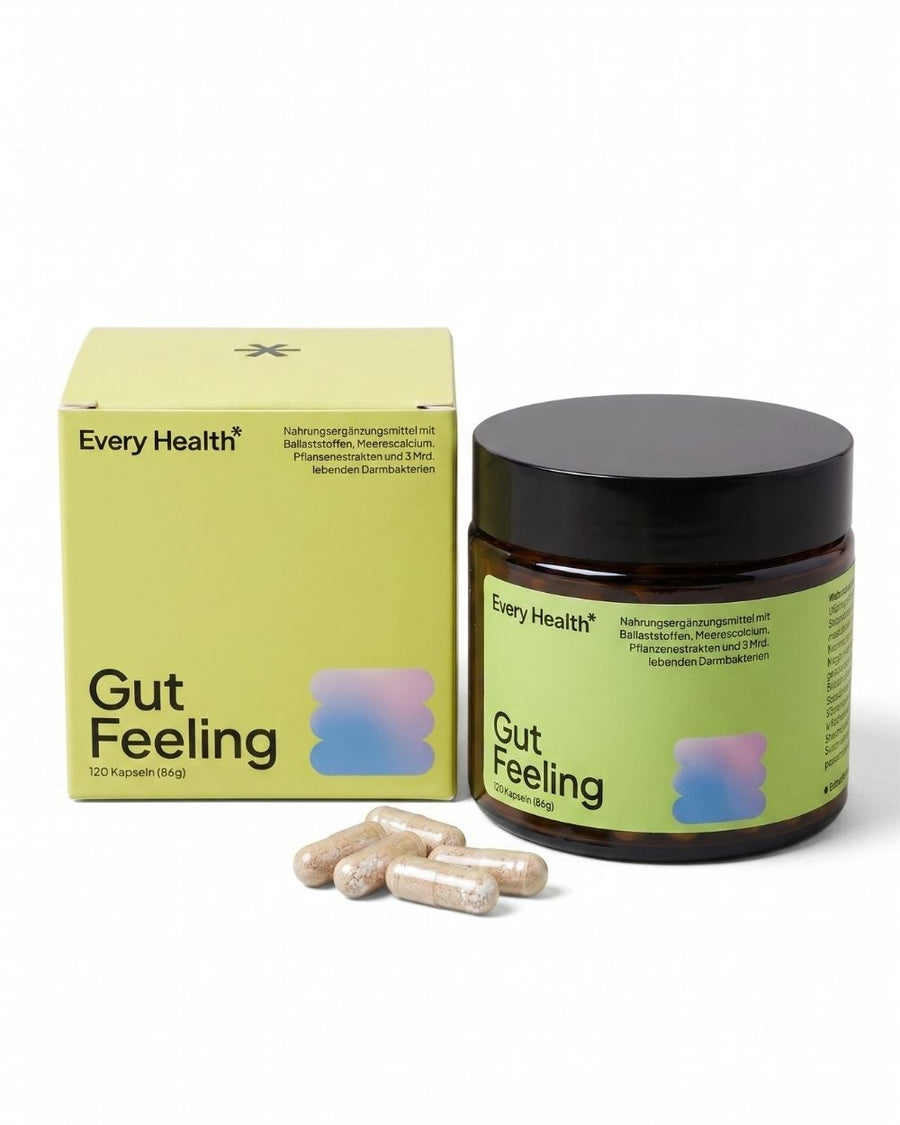
For the daily basics, Gut Feeling is designed for exactly that: a simple routine for your gut without rebuilding half your life around it. Not a miracle cure and not a substitute for a medical assessment, but a building block that is realistic to keep up.
Your gut is not a reason to go without
IBS is exhausting, unpredictable and socially awkward. What it isn't: a reason to cut out intimacy.
Most people living with it arrive at the same place eventually. The gut hasn't changed, the way of handling it has. Less fighting, more planning. Less hiding, more saying it out loud. And considerably less catastrophe than feared.