





Heimtest auf Geschlechtskrankheiten
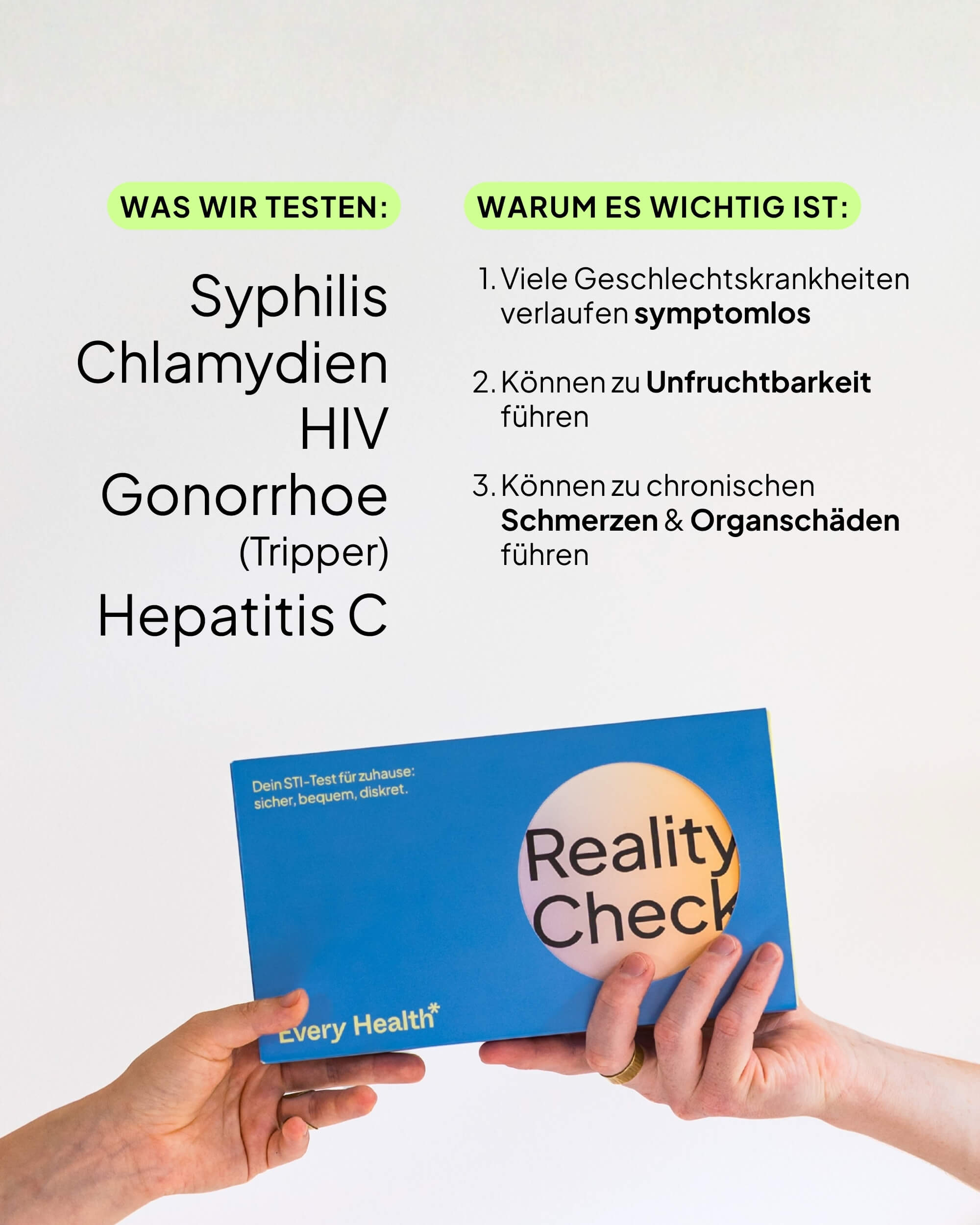
- Test auf 5 der häufigsten STIs
- Ergebnis schon 24 h nach Laboreingang durch akkreditiertes Fachlabor
- In nur 10 Minuten zuhause durchführbar, inkl. medizinischer Beratung
Darauf testen wir

Infektionen verlaufen oft symptomlos
Jeden Tag infizieren sich weltweit über 1 Million Menschen mit STIs
Chlamydien sind bakterielle Infektionen der Schleimhäute, verursacht durch das Bakterium Chlamydia trachomatis. Sie führen vor allem zu Entzündungen der Harnröhre, des Genitaltrakts und des Enddarms.
Ansteckung über:
 Oral
Oral
 Anal
Anal
 Vaginal
Wenn Symptome auftreten, zeigen sie sich ein bis drei Wochen nach der Infektion: Ausfluss aus der Harnröhre oder Vagina, Jucken, Brennen und Schmerzen beim Wasserlassen. Bei Frauen verläuft die Infektion häufig symptomlos.
Die Übertragung erfolgt beim Geschlechtsverkehr durch direkten Schleimhautkontakt: vaginal, anal oder oral. Auch bei der Geburt können Chlamydien von der Mutter auf das Neugeborene übertragen werden.
Chlamydien sind mit Antibiotika gut behandelbar. Wichtig ist die vollständige Einnahme und dass Sexualpartner mitbehandelt werden, um eine Reinfektion zu verhindern.
Unbehandelt können Chlamydien zu Unterleibsentzündungen, Entzündungen der Prostata, Hoden und Nebenhoden sowie Unfruchtbarkeit führen. Bei der Frau kann die Infektion die Eileiter verkleben und den Transport der Eizelle unmöglich machen.
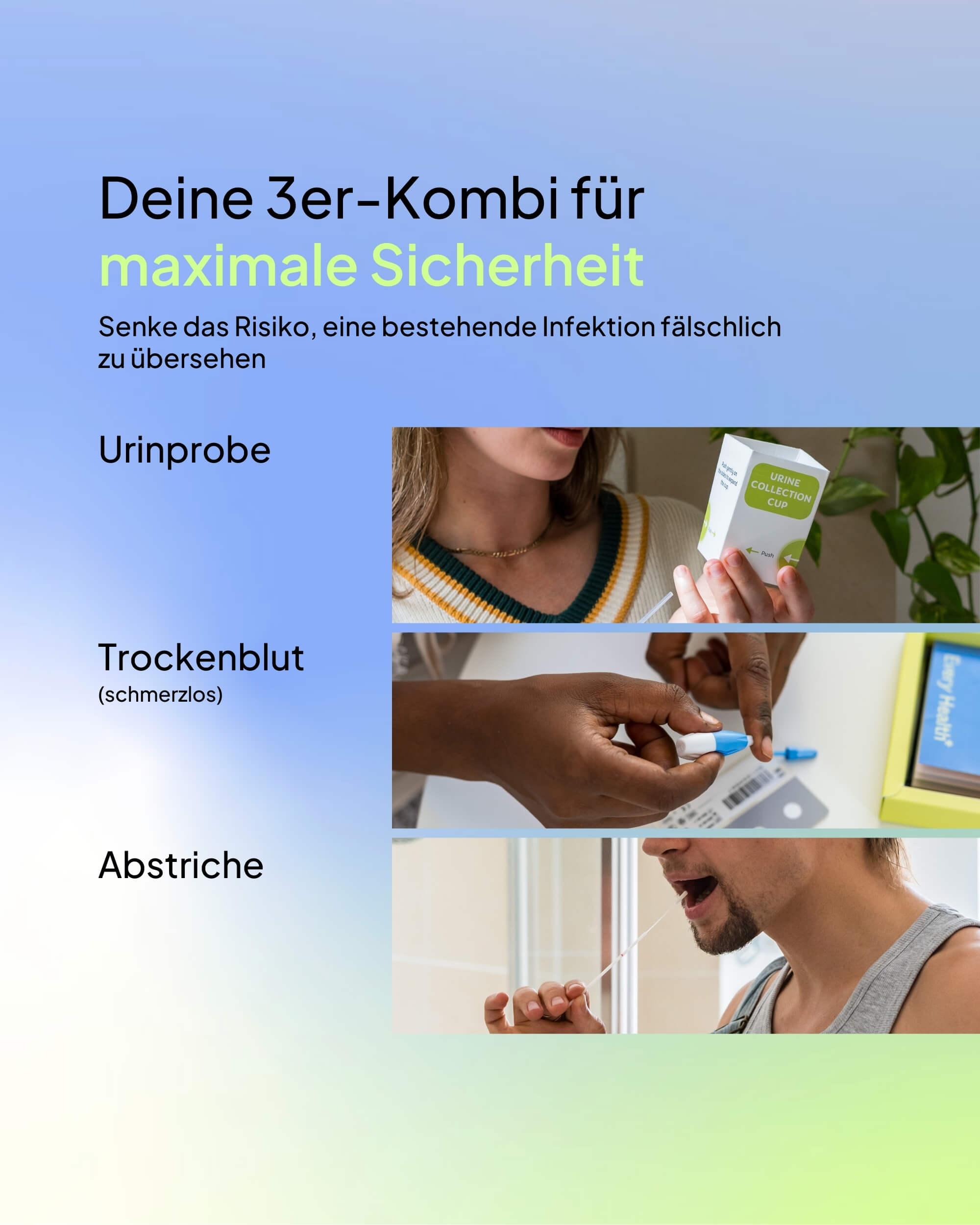
Unser Partnerlabor weist Chlamydien per PCR nach, also mit dem Verfahren, das auch in der ärztlichen Diagnostik eingesetzt wird. Dein Kit enthält eine Urinprobe sowie Abstriche für Rachen und Enddarm, damit alle drei Übertragungswege erfasst werden.
Der Test erfasst Kontakte, die mindestens 7 Tage zurückliegen, sicher nachweisbar ist eine Infektion nach 10 bis 14 Tagen.
Syphilis ist eine bakterielle Infektionserkrankung, verursacht durch das Bakterium Treponema pallidum. Sie verläuft in mehreren Stadien und kann unbehandelt Haut, Schleimhäute, Lymphknoten sowie das Herz-Kreislauf- und Nervensystem befallen.
Ansteckung über:
Oral
Anal
Vaginal
Stadium 1: schmerzloses Geschwür (Ulcus durum) an der Eintrittsstelle. Stadium 2 (Wochen später): Hautausschlag, Fieber und Lymphknotenschwellung. Stadium 3: schwerwiegende Schäden an Herz, Gehirn und anderen Organen.
Syphilis wird durch direkten Kontakt mit einem Syphilis-Geschwür übertragen, meist beim ungeschützten Geschlechtsverkehr (vaginal, anal oder oral). Eine Übertragung über infizierten Hautkontakt ist ebenfalls möglich.
Syphilis ist mit Antibiotika gut und in frühen Stadien vollständig heilbar. Wichtig ist die vollständige Therapie sowie die Behandlung aller Sexualpartner.
Unbehandelt kann Syphilis zu schwerwiegenden Schäden an Herz-Kreislauf-System und Nervensystem führen. Im dritten Stadium drohen Lähmungen, Demenz und Erblindung (Neurosyphilis).
Es wird ein Lues-Suchtest eingesetzt, der IgG- und IgM-Antikörper erfasst. Auch hier genügen wenige Tropfen Blut aus der Fingerkuppe auf einer Trockenblutkarte.
Der Test erfasst Kontakte, die etwa 6 Wochen zurückliegen.
Ein reaktives Ergebnis ist noch keine Diagnose. Es sollte immer durch einen Bestätigungstest abgeklärt werden. Das ist auch deshalb wichtig, weil Antikörper nach einer ausgeheilten Syphilis oft dauerhaft nachweisbar bleiben und der Suchtest allein deshalb nicht zwischen einer aktuellen und einer früheren Infektion unterscheiden kann. Wir arbeiten an einer Funktion, die das auch bei unserem Test berücksichtigt.
HIV (Humanes Immundefizienz-Virus) greift gezielt CD4-Zellen (T-Helferzellen) des Immunsystems an und schwächt es über Zeit. Unbehandelt kann die Infektion zu AIDS fortschreiten, dem Stadium, in dem das Immunsystem so geschwächt ist, dass lebensbedrohliche Erkrankungen auftreten.
Ansteckung über:
 Blut
Vaginal
Anal
Blut
Vaginal
Anal
Kurz nach der Infektion: grippeähnliche Symptome (Fieber, Abgeschlagenheit, Lymphknotenschwellung). Danach oft jahrelang keine Beschwerden. Im AIDS-Stadium: schwere opportunistische Infektionen und Gewichtsverlust.
HIV wird durch infektiöse Körperflüssigkeiten übertragen: Blut, Sperma, Scheidensekret und Muttermilch. Hauptübertragungswege sind ungeschützter Geschlechtsverkehr und die gemeinsame Nutzung von Spritzen.
HIV ist nicht heilbar, aber mit antiretroviraler Therapie (ART) sehr gut kontrollierbar. Bei konsequenter ART sinkt die Viruslast unter die Nachweisgrenze. Damit ist keine Übertragung mehr möglich (U=U: Undetectable = Untransmittable).
Ohne Behandlung schreitet HIV zu AIDS fort, verbunden mit lebensbedrohlichen Infektionen und Tumoren. Mit frühzeitiger ART ist eine nahezu normale Lebenserwartung möglich.
In unserem Partnerlabor kommt ein HIV-1/2-Suchtest der 4. Generation zum Einsatz. Er weist nicht nur Antikörper nach, sondern zusätzlich das p24-Antigen, das schon deutlich früher im Blut auftritt. Dafür genügen wenige Tropfen Blut aus der Fingerkuppe, die du auf eine Trockenblutkarte aufträgst und ins Labor schickst.
Dadurch erfasst der Test bereits Kontakte, die 6 Wochen zurückliegen.
Ein reaktives Ergebnis ist noch keine Diagnose. Es wird immer durch einen Bestätigungstest abgeklärt.
Gonorrhoe (Tripper) ist eine bakterielle Infektionserkrankung durch Neisseria gonorrhoeae. Sie befällt vor allem die Schleimhäute der Harnröhre, des Gebärmutterhalses, des Enddarms und des Rachens. Ansteckung über:
Oral
Anal
Vaginal
Eitriger Ausfluss aus der Harnröhre oder Vagina, Brennen und Schmerzen beim Wasserlassen. Bei rektaler Infektion: Ausfluss und Schmerzen im Enddarm. Bei Frauen verläuft die Infektion häufig symptomlos.
Gonorrhoe wird durch ungeschützten Geschlechtsverkehr übertragen: vaginal, anal und oral. Eine Übertragung von der Mutter auf das Neugeborene während der Geburt (Bindehautentzündung) ist ebenfalls möglich.
Die Behandlung erfolgt mit Antibiotika. Aufgrund zunehmender Resistenzen erfordert Gonorrhoe eine gezielte Therapie. Sexualpartner müssen mitbehandelt werden.
Unbehandelt kann Gonorrhoe zu entzündlichen Erkrankungen der Beckenorgane, Unfruchtbarkeit und chronischen Schmerzen führen. Bei Männern droht eine Nebenhodenentzündung (Epididymitis).
Unser Partnerlabor weist Gonorrhoe per PCR nach, aus Urin sowie aus Rachen- und Enddarmabstrich. Gerade im Rachen verlaufen diese Infektionen sehr oft ohne Symptome und werden bei reinen Urintests übersehen.
Der Test erfasst Kontakte, die mindestens 7 Tage zurückliegen, sicher nachweisbar ist eine Infektion nach 10 bis 14 Tagen.
Hepatitis C ist eine virale Lebererkrankung, verursacht durch das Hepatitis-C-Virus (HCV). Sie kann akut oder chronisch verlaufen und langfristig zu einer Entzündung des Lebergewebes, Leberzirrhose oder Leberkrebs führen. Ansteckung über:
Blut
Anal
In der Akutphase häufig symptomlos. Wenn Symptome auftreten: Müdigkeit, Gelbfärbung der Haut und Augen (Ikterus), Übelkeit und Druckgefühl im Oberbauch. Chronische Verläufe bleiben oft jahrelang unbemerkt.
Hepatitis C wird hauptsächlich durch Blutkontakt übertragen, z. B. durch gemeinsame Nutzung von Nadeln, unsterile Tätowiernadeln oder medizinische Instrumente. Eine sexuelle Übertragung ist selten, kann aber insbesondere beim Analverkehr vorkommen, da es hierbei oft zu kleinen Schleimhautverletzungen und damit unbemerktem Blutkontakt kommt.
Hepatitis C ist mit modernen direkt antiviralen Medikamenten (DAAs) in über 95 % der Fälle heilbar, in der Regel innerhalb von 8–12 Wochen ohne nennenswerte Nebenwirkungen.
Eine chronische Hepatitis-C-Infektion kann über Jahre zu Leberfibrose und Leberzirrhose führen. Im schlimmsten Fall entsteht ein hepatozelluläres Karzinom (Leberkrebs).
Unser Partnerlabor arbeitet mit einem Antikörpertest, ebenfalls aus Trockenblut von der Fingerkuppe.
Antikörper bildet der Körper erst nach einiger Zeit. Der Test erfasst deshalb Kontakte, die mindestens 12 Wochen zurückliegen.
Ein reaktives Ergebnis wird durch eine zusätzliche Untersuchung abgeklärt, die zeigt, ob die Infektion noch aktiv ist.


Damit's [nicht brennt]
Nur auf Urin und Blut testen? Das ist wie Rauchmelder in jedem Zimmer zu montieren nur nicht in Küche und Schlafzimmer. Also genau da, wo es am häufigsten brennt.
Lieber umfassend
Wir testen auch oral und rektal, denn ohne Abstriche ist es [kein] Reality Check.
Lieber umfassend
Wir testen auch oral und rektal, denn ohne Abstriche ist es [kein] Reality Check.
So funktioniert's

1. Testkit
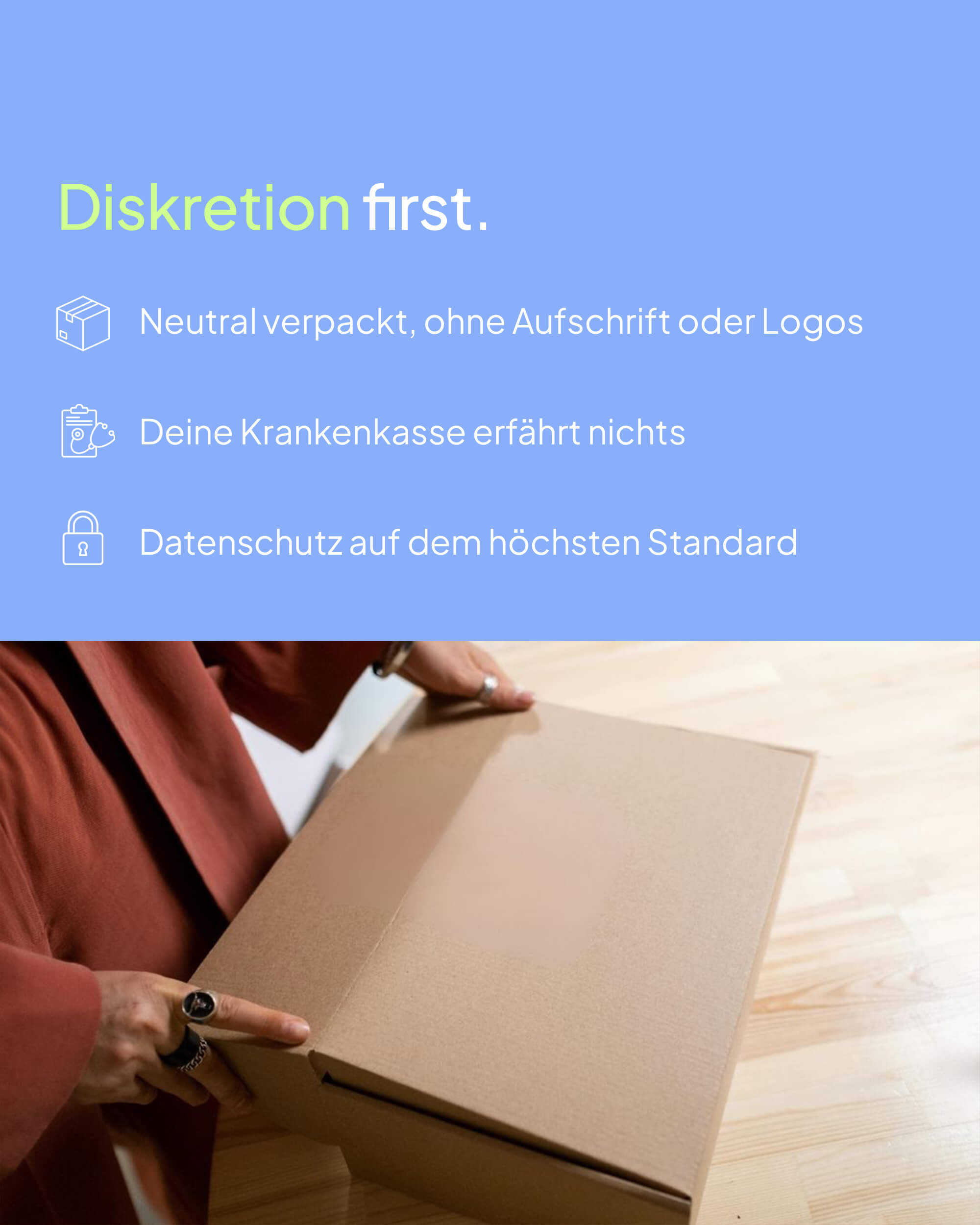
Bestelle deinen Reality Check einfach online und erhalte ihn innerhalb weniger Tage nach Hause. Dein Paket wird diskret und neutral verpackt, sodass niemand den Inhalt erkennt.

2. Aktivierung
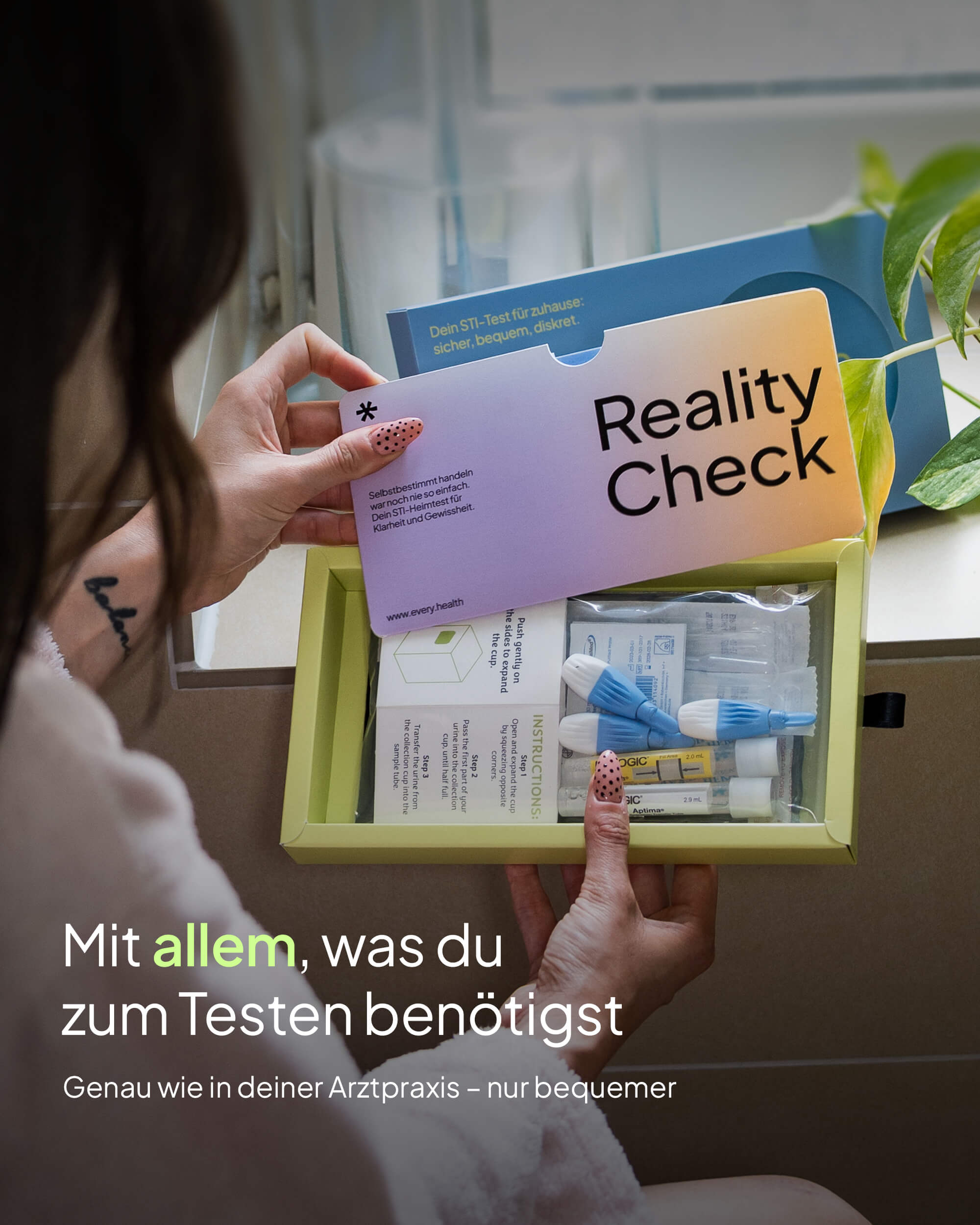
Aktiviere deinen Test mit dem beiliegenden QR-Code. Dein Reality Check bringt alles mit, was du für die Durchführung des Tests brauchst, inklusive Anleitung.

3. Proben
Entnehme die Proben gemäß der beiliegenden Anleitung, verpacke sie wie dort beschrieben und sende sie im Rückumschlag kostenfrei an unser Partnerlabor.

4. Resultate
Sobald deine Proben bei unserem Partnerlabor eingetroffen sind, erhältst du deine Ergebnisse innerhalb von 24 Stunden: digital, sicher und absolut vertraulich.


So schützt du dich
effektiv vor STIs
- Kommunikation: Ein offenes Gespräch über sexuelle Gesundheit zeigt Verantwortung. Sprich über den letzten Test, Schutzmaßnahmen und sexuelle Gesundheit – das schützt beide Partner und schafft Vertrauen.
- Kondome & Femidome: Sie schützen sehr zuverlässig vor HIV und senken das Risiko für Chlamydien, Gonorrhö und Trichomonaden erheblich. Allerdings bieten sie keinen 100-prozentigen Schutz, da einige STIs wie Herpes oder Syphilis auch über unbedeckte Hautbereiche übertragen werden können.
- Regelmäßige STI-Tests: Da viele STIs symptomlos verlaufen, sind aber bei rechtzeitiger Diagnose gut bis vollständig behandelbar. Bei wechselnden Partnern wird ein Test alle 3-6 Monate empfohlen.


[Don’t panic,] we got you!
Falls dein Test positiv ausfällt, lassen wir dich nicht allein. Wir bieten dir umfassende Hilfestellung mit verständlichen Informationen zu deinem Ergebnis und den nächsten Schritten. Bei Bedarf vermitteln wir dich auch an passende Ärzte in deiner Nähe. Je früher eine Infektion erkannt wird, desto einfacher ist die Behandlung. Mit unserem Test erhältst du dein Ergebnis bereits 24h nach Laboreingang.
Negativ getestet,
[[positiv]] begeistert
Das sagen unsere Nutzer*innen über uns
Negativ getestet,
[[positiv]] begeistert
Das sagen unsere Nutzer*innen über uns

Lina, 29
Ablauf war super einfach und die Anleitung verständlich. Die Ergebnisse kamen viel [[[schneller als bei anderen Tests]]]. Nie wieder woanders!

Fabian, 37
Endlich ein Test, bei dem ich mich nicht unwohl gefühlt hab. [[[Lebensqualität]]] direkt gestiegen. Ich komme definitiv wieder! Danke, danke, danke!

Laura, 34
Der Test war wirklich unkompliziert. Toll fand ich, dass [[[alles vertraulich]]] ablief. Das gibt mir zusätzlich ein gutes Gefühl.

Noah, 25
[[[Einfacher geht's nicht.]]] Keine Wartezeiten auf Termine, Ärzte etc. Spart auch auch diesen ganzen Cringe, der damit verbunden ist. Absolute Empfehlung.

Mary, 24
Der erste Test, der mich nicht in Unruhe zurückgelassen hat. Besonders überzeugt hat mich, wie [[[gut durchdacht]]] das Ganze ist. Danke für den tollen Service.


Erhältlich auch in [deiner] Apotheke
Deinen Reality Check findest du auch vor Ort und kannst ihn direkt mitnehmen.Dirty Talk
STIs, Testablauf, Diskretion? Frag uns alles, was du willst

Unser Test erkennt zuverlässig fünf der häufigsten sexuell übertragbaren Infektionen: Chlamydien, Gonorrhö (Tripper), Syphilis, Hepatitis C und HIV.
Du bestellst dein Testkit bequem online und erhältst es diskret verpackt nach Hause. Dort entnimmst du die Proben, folgst der beiliegenden Anleitung und sendest sie im kostenfreien Rückumschlag an unser zertifiziertes Partnerlabor. Dein Ergebnis erhältst du anschließend sicher und vertraulich digital in deinem Konto bei Every Health.
Der Rückversand per Post dauert ca. 1-3 Werktage. Sobald deine Proben im Partnerlabor eingetroffen sind, wird die Auswertung umgehend gestartet. Ab diesem Zeitpunkt erhältst du deine Ergebnisse in der Regel innerhalb von 24 Stunden: digital, sicher und nur für dich zugänglich. Wir benachrichtigen dich sofort, sobald sie vorliegen. Bitte beachte, dass Wochenenden und Feiertage den Prozess entsprechend verzögern können.
Wir legen größten Wert auf Datenschutz. Deine Bestellung erfolgt in neutraler Verpackung ohne Hinweise auf den Inhalt. Die Auswertung im Labor erfolgt anonymisiert und deine Ergebnisse werden ausschließlich DSGVO-konform und verschlüsselt in deinem sicheren Kundenkonto bereitgestellt.
Schaue gerne in unseren FAQ vorbei. Da haben wir viele Informationen für dich zusammengetragen und aktualisieren sie fortlaufend.